
I finally brought WinFormsVncDemo onto a real VNC path
March 24, 2026. I wanted to capture one result from this round in a news-style format:
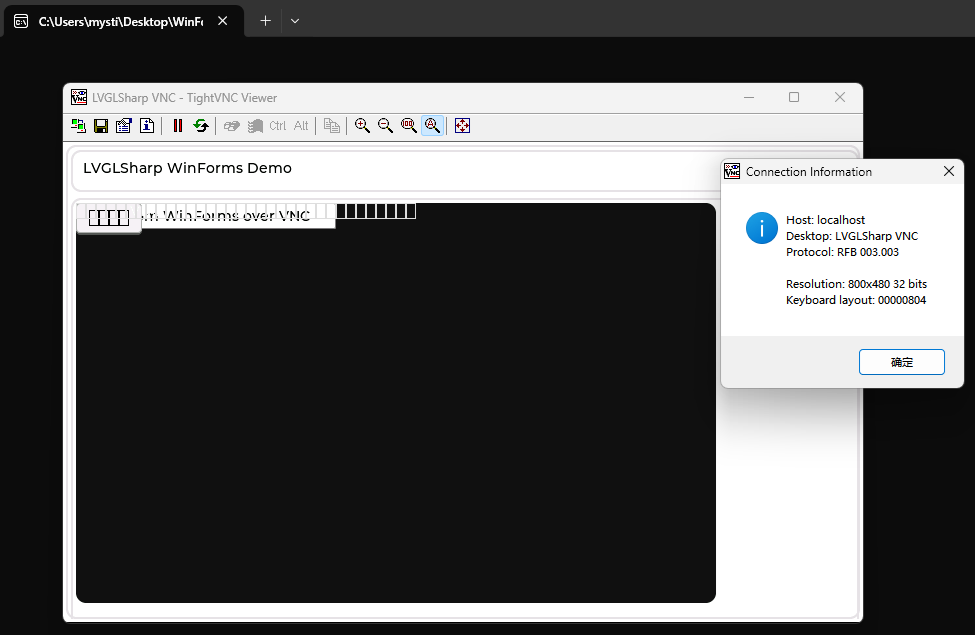
WinFormsVncDemois no longer just a local window sample. It can now run directly onVncViewand be reached from a desktop VNC client.
The key changes I pushed forward in this round
- I kept
VncViewandRdpViewas the public entry points instead of hiding them under internal subdirectories. - I reorganized the internal remote runtime implementation into
Frames,Input,Transport,Session, andViews, so the boundaries around transport, input, and frame handling are much clearer. - I pulled VNC host, port, and window-size details back into runtime registration, so
Programonce again only starts the app and the demo itself no longer owns remote session wiring. - I added a default construction path for
VncView, which lets the demo come up with sensible defaults now without blocking a futureViewOptionsdesign. - I made the demo print port
5900and the locally reachable addresses to the console at startup, so the first-run experience immediately tells you where to connect. - I fixed the native-runtime publishing behavior in
LVGLSharp.Native.targets, so Windows self-contained / AOT output carries the requiredlvgl.dllinstead of failing later withDllNotFoundException. - I also moved the Windows-side VNC Viewer screenshot for
WinFormsVncDemointo the docs, so this work is represented by a real, shareable runtime case instead of words alone.
Why I think this deserved a news entry
Before this round, the path felt more like something that could be pieced together. Now it feels much closer to something I can hand to someone else to try. The biggest win for me is not just that a demo launches, but that the responsibilities are cleaner: the public entry is simple, the internal runtime layers are easier to read, the demo startup path stays clean, and the published output is much more believable.
That gives us a stronger baseline for the next stage: a normal WinForms-style UI can now be hosted by VncView, exposed as a VNC service, and opened from a desktop client. That is a practical step forward for remote-host scenarios, automation, and a more formal configuration story later.
What I want to keep improving next
- I want to keep shaping the remote runtime configuration into a clearer
ViewOptionsmodel. - I want to keep adding real-case screenshots instead of describing progress only in text.
- I want the publish pipeline to keep moving toward “take the output and test it directly,” with less gap between demo code and real deployment.